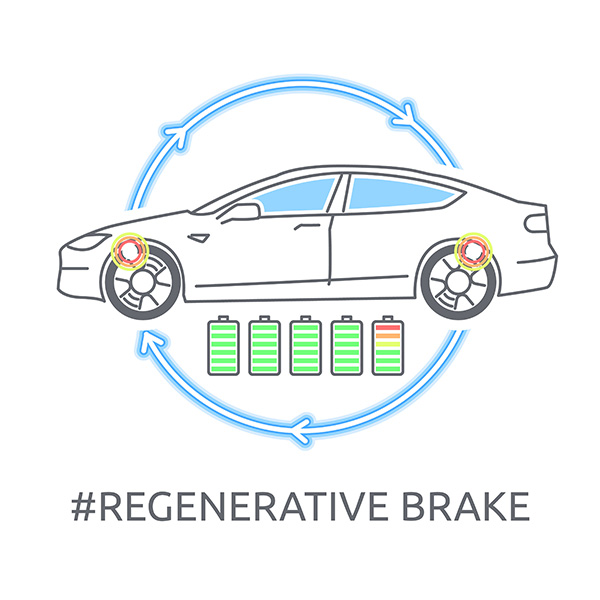
Regenerative braking sounds like a simple win: slow down, get energy back, done. In practice, it depends on battery temperature, state of charge, traction, and how the car blends braking behind the scenes. That is why two drives that feel similar can return very different amounts of energy.
Once you know what the system is trying to do, the quirks start making more sense.
What Regenerative Braking Is Actually Doing
Regenerative braking uses the drive motor as a generator when you slow down. Instead of turning the car’s motion into heat at the brake pads, the motor resists rotation and creates electricity. That electrical energy is sent back through the power electronics and into the battery. You still slow down, but the energy has somewhere useful to go.
It is not a free-energy trick, though. There are conversion losses at each step, so you never get back everything you spent to accelerate. What you do get back is often enough to improve range and reduce wear on friction brakes. That is why regen can feel like the car is doing a bit of braking on its own when you lift off the pedal.
Where The Energy Goes And Why Speed Matters
The faster you are moving, the more kinetic energy is available to capture during deceleration. Gentle, longer slowdowns usually allow more energy recovery than a late, hard stop. That is because the system has time to generate current without hitting its limits. At very low speeds, regen fades and the car needs the traditional brakes to finish the stop.
Hills are another big factor. On a long downhill, regen can keep feeding energy back until the battery reaches a limit. Once that limit is reached, the vehicle has to reduce regen and rely more on friction braking. That is also why some drivers notice their brakes feel change after a long descent.
How The Car Decides Between Regen And Brake Pads
Most EVs and hybrids use blended braking, which means the car mixes regen and friction brakes to meet the deceleration you ask for. If you press lightly, it may favor regen first. If you press harder or grip is limited, it may cause quick friction braking. The goal is stable stopping with a consistent feel at the pedal.
This blending is happening constantly, and it can change from one moment to the next. Battery state of charge, battery temperature, and motor limits all affect how much regen is available. If the car cannot accept more energy, it cannot generate as much braking force through the motor, so the pads do more of the work.
Why Regen Sometimes Feels Weak Or Inconsistent
Cold weather can reduce regen because a cold battery cannot accept a charge as aggressively. A full battery can do the same thing, because there is simply not much room to store recovered energy. Traction control events can also cut regen, since the car prioritizes stability over energy capture. Even a slightly slippery road can make the system back off.
You may notice this most right after starting the vehicle on a cold morning or right after a full charge. The car can still slow down, but it may lean more on friction braking until conditions improve. If the change is sudden and repeatable, it is worth paying attention to whether it lines up with temperature, charge level, or downhill driving.
What Changes In Feel And Noise Are Worth Noting
Regen can create a different driving feel, especially if your car supports one-pedal driving. Lift-off deceleration can feel stronger than drivers expect at first, then feel lighter at other times. Some EVs also have a faint whirring or electrical tone during regen, which can be more noticeable in quiet cabins. That sound is usually the motor and inverter doing their work, not a brake problem.
What matters is whether the feeling changes in a way that seems unrelated to conditions. If the brake pedal suddenly feels softer, travel increases, or stopping feels uneven, an inspection can help confirm whether it is a braking system issue or a blending behavior you are noticing for the first time. It is also smart to watch for vibration during braking, since that can point to rotor surface issues that regen cannot prevent. Hybrids in particular can develop light rotor rust if friction brakes are used less often.
Simple Ways To Get More Range From Regen
The best gains usually come from slowing down earlier and more gradually, so the system can capture more energy. It also helps to learn how your specific vehicle responds in its different regen modes. Some settings increase lift-off regen, while others prioritize coasting. You do not have to drive slowly to benefit; you just have to drive with fewer last-second stops.
A few habits that often help, especially as part of regular maintenance of your driving routine:
- Ease off earlier and let regen do more of the slowdown
- Use a consistent following distance so you are not constantly braking hard
- Avoid topping off to 100% right before a long downhill drive if you have a choice
- If your car has regen modes, try one for a week and see how it affects your commute
It is also a good idea to use the friction brakes firmly once in a while in a safe place. That helps clean surface rust off rotors and keeps the pads moving freely. The goal is balanced braking health, not trying to avoid the brake pedal completely.
Get EV And Hybrid Brake Service In Corpus Christi, TX, With Romay's Auto Service
If you want your braking system and regen behavior checked as a team, Romay's Auto Service in Corpus Christi, TX, can help you understand what your vehicle is doing and confirm everything is working as it should.
Set up a visit and get a clear answer you can drive with.