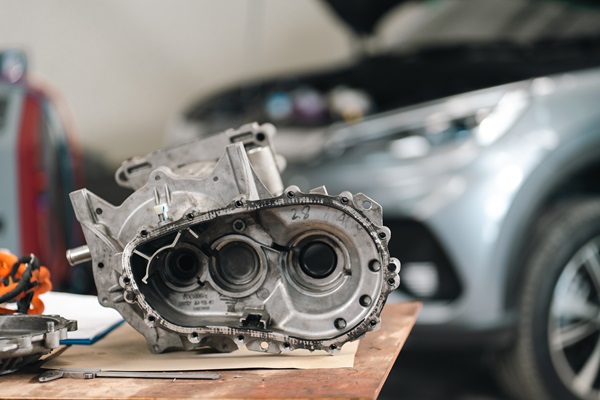
An electric vehicle does not need the same multi-speed transmission found in many gasoline cars, but its motor still has to transfer power to the wheels. In most EVs, a reduction gear assembly lowers motor speed and increases the torque delivered through the drive unit. Those gears and bearings still need lubrication.
The important qualification is that not every EV requires a routine gear-oil change at the same interval. Some manufacturers call for inspections, some specify replacement under particular conditions, and others do not list a regular change. The exact drive unit and maintenance instructions decide what service is appropriate.
EV Reduction Gears Turn Motor Speed Into Wheel Torque
An electric motor can operate across a wide speed range, so many EVs use a single fixed reduction ratio. The gearset reduces the motor's fast rotation to a speed suitable for the wheels. A differential may be part of the same assembly, allowing the driven wheels to turn at different speeds during a corner.
A single-speed layout has fewer shifting components than a conventional automatic transmission, but it is still a mechanical assembly. Teeth mesh, bearings carry loads, and seals retain lubricant. Some EVs use more than one drive unit, and their front and rear assemblies may have different requirements. The absence of gear changes does not remove these mechanical functions.
Gear Oil Protects EV Bearings and Contact Surfaces
The oil forms a protective film between moving surfaces and helps manage heat within the assembly. Its formulation must suit the loads, materials, and operating conditions of that drive unit. In certain designs, the fluid interacts with additional motor or cooling components, making the required specification especially important.
Gear lubricant differs from engine oil because it does not lubricate a combustion engine. Don't choose it by assuming any familiar oil will work. Even two products described as gear fluid may differ in properties and compatibility. The specified product and correct fill procedure are part of the service, not optional details.
EV Gear-Fluid Service Intervals Are Model Specific
Check the maintenance information for the exact year and model. The requirement to inspect fluid differs from a scheduled replacement requirement. Severe operation, a repair, or another condition the manufacturer identifies may call for additional service, but you shouldn't invent a universal interval for every electric vehicle.
Likewise, a missing routine change interval does not mean the drive unit needs no attention for its entire life. Leaks, contamination, noise, and component repairs may still require inspection or fluid work. A service recommendation should explain the manufacturer’s instruction or the observed condition that makes the work appropriate.
EV Oil Leaks Can Reduce Drive-Unit Lubrication
A leaking seal or damaged housing can lower the lubricant level even if no scheduled change is due. EV drive-unit leaks may be small enough to appear as residue rather than a large puddle. Identifying the fluid and its source is necessary because coolant, brake fluid, and other liquids can also appear beneath an electric vehicle.
A top-off should not be treated as a complete repair for a recurring leak. The technician needs to establish why fluid is escaping and whether the assembly has operated low. Whining, grinding, or another new driveline sound can have several causes, so evaluate the drive unit and nearby wheel or axle components together.
EV Gear-Oil Service Needs the Correct Fill Procedure
The required quantity, level-check method, temperature conditions, and seals or plugs vary by drive unit. Overfilling adds no protection, and underfilling can leave working surfaces without adequate lubrication. Some assemblies have procedures that differ substantially from a simple drain-and-fill on a traditional axle.
Service access may also be close to high-voltage equipment. Owners should avoid opening a drive unit or working around high-voltage connections without the required training and procedures. A maintenance visit should identify the assembly and follow the manufacturer’s instructions, including any precautions needed to perform the work safely.
EV Maintenance Records Should Identify the Drive Unit
A clear receipt should state which assembly was serviced and which fluid was used. This is especially useful on vehicles with front and rear motors, where work on one unit does not confirm both were serviced. It also helps the next technician understand whether a noise or leak began before or after the fluid work.
Avoid assuming that an EV needs a generic transmission flush because another car received one. Assembly design and service instructions come first. Keeping the correct lubricant in a healthy drive unit supports its operation, while an inspection can determine whether maintenance, a leak repair, or further testing is needed.
Discuss EV Reduction-Gear Oil Service in Corpus Christi, TX, With Romay’s Auto Service
If you are unsure what the reduction gears in your EV require, bring the model information and service records to Romay’s Auto Service in Corpus Christi, TX. We can review the applicable maintenance guidance and discuss a leak, noise, or service concern so the next step is based on the drive unit your vehicle actually uses.
Contact us to discuss an EV drive-unit maintenance inspection.